
Capabilities
Practical insight for complex structural & manufacturing challenges
Explore the services, methods, and analytical questions we support. For examples of completed work and project outcomes, visit Experience.
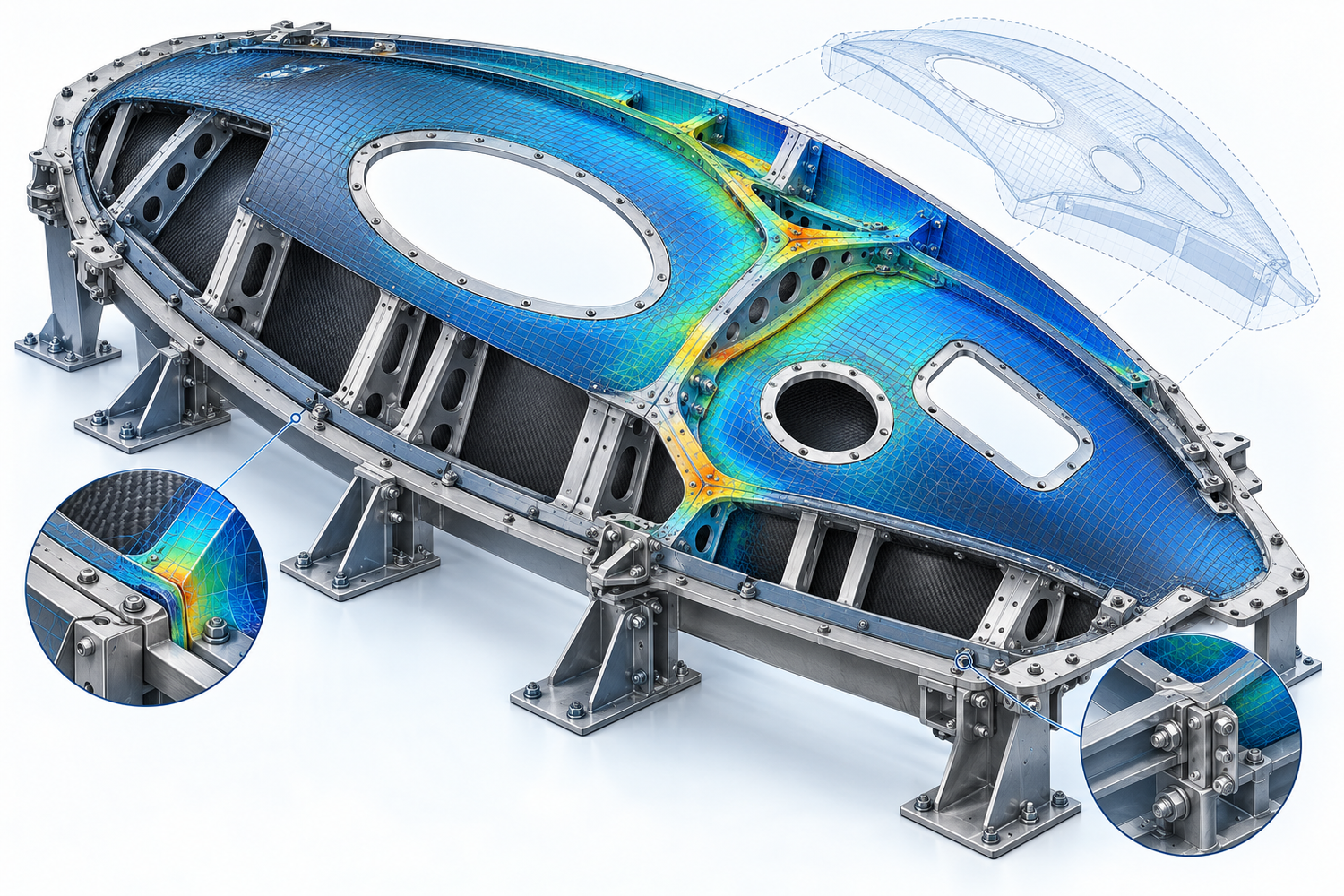
Catlow Consulting provides analytical and technical consulting in support of manufacturers and their engineering teams. Where licensed engineering or Engineer-of-Record services are required, we work collaboratively with the appropriate licensed professionals.
Structural Systems Analysis
We examine how structural systems and manufactured components respond to defined conditions and assumptions. Members, connections, bracing, and supports interact: a local change can redirect load paths and influence the behavior of the whole system.
Useful when: A component deforms unexpectedly, load paths are unclear, or system behavior needs investigation.
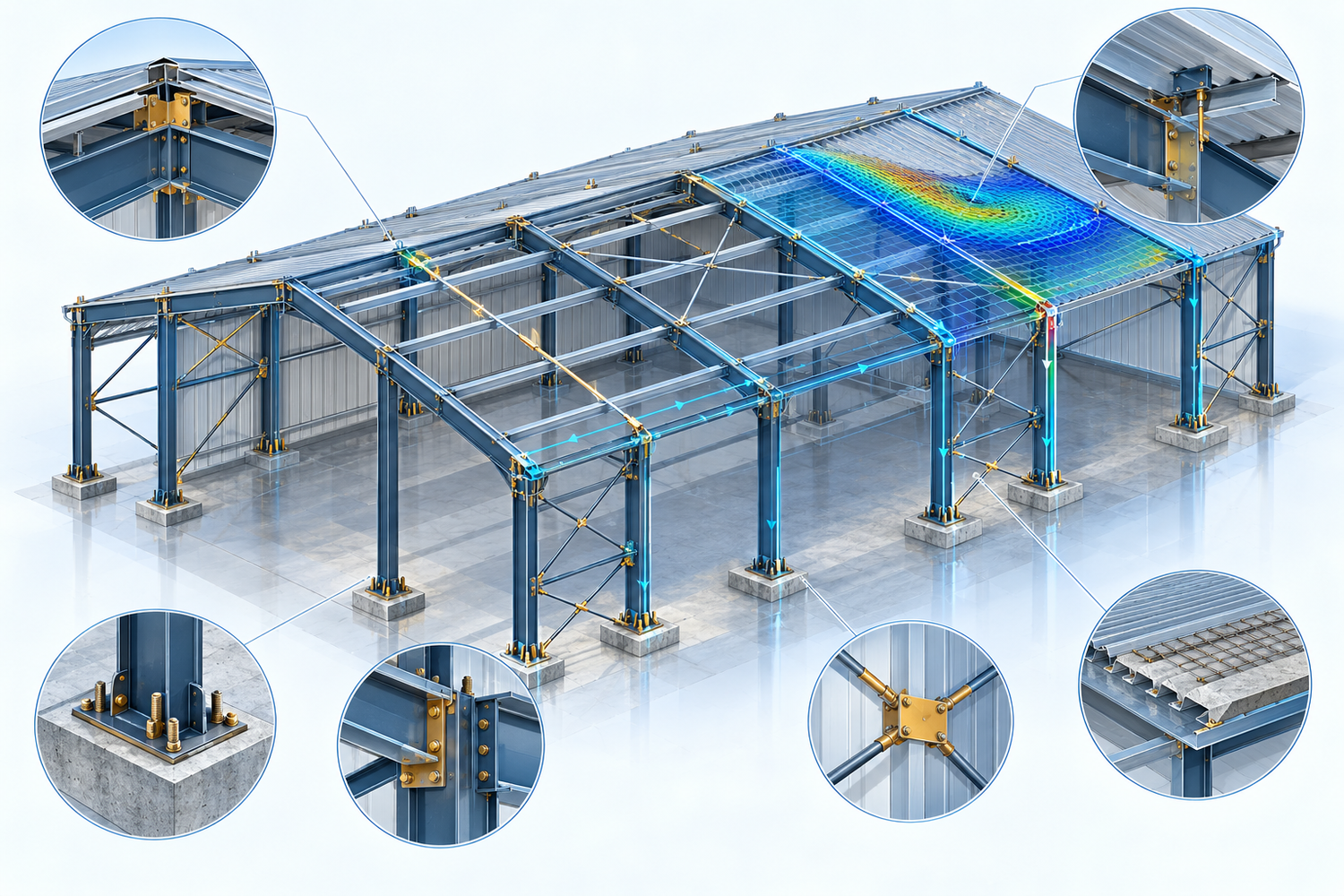
Analysis Scope
This often includes:
Evaluating load paths and system behavior
Reviewing potential failure modes or performance concerns
Assessing how changes in geometry, materials, or detailing may affect behavior
Identifying areas where additional engineering attention may be warranted
Understanding how reliability is influenced by design lineage, manufacturing variation, and installation practice
Simulation & Reliability
We use finite element analysis (FEA), simulation, and structured reliability framing to explore how systems behave under defined conditions. Mesh connectivity, support assumptions, and load scenarios help us examine local response and compare possible system behavior.
Useful when: Loading assumptions are uncertain, behavior is sensitive to small changes, or alternatives need comparison.
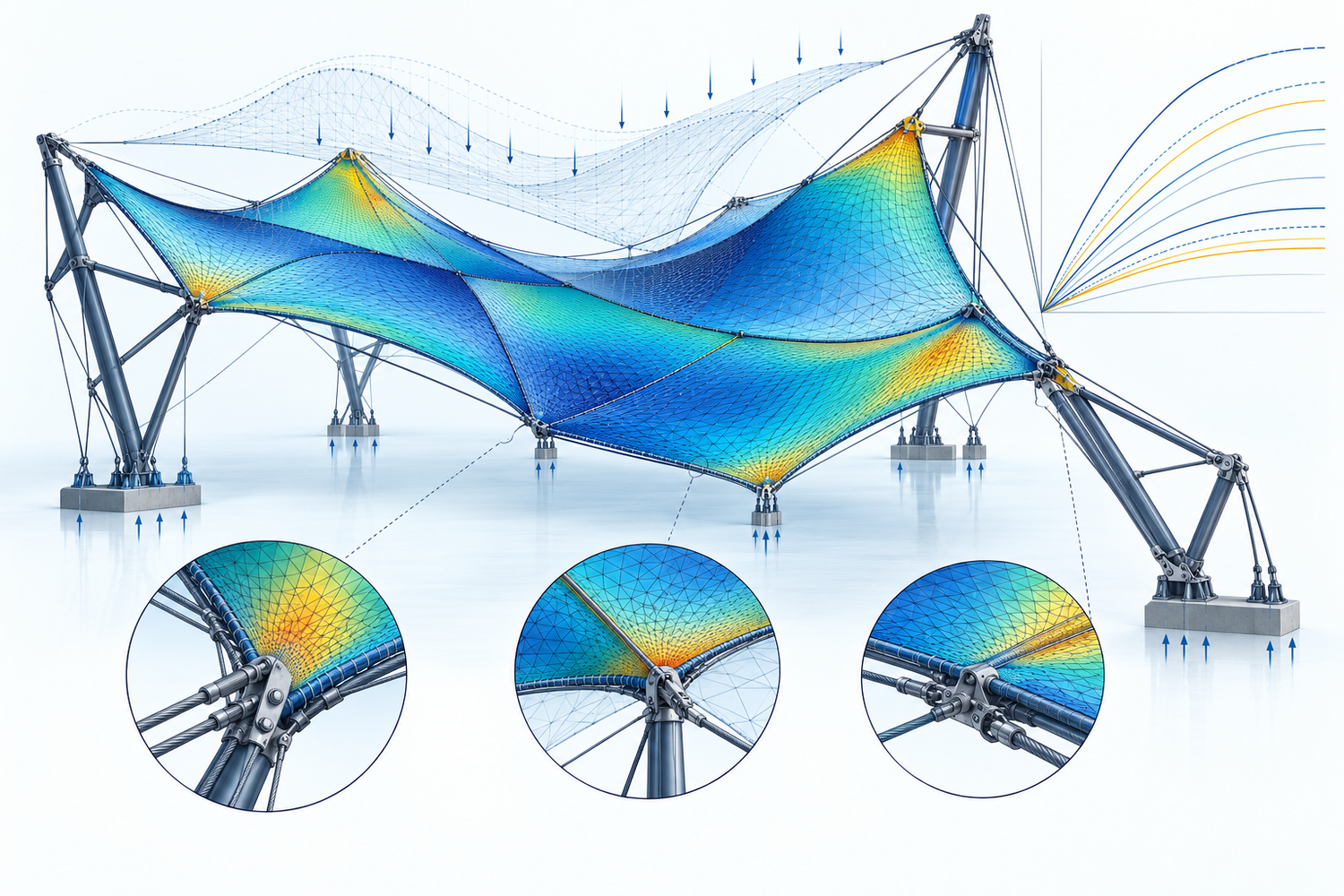
Simulation & Reliability Methods
Finite Element Analysis, Simulation, and Reliability Framing
Typical applications include:
Comparing alternative configurations or design concepts
Investigating nonlinear or sensitivity-driven behavior
Exploring “what-if” scenarios to understand how assumptions influence results
Identifying which variables most influence reliability or performance
Communicating findings in a clear, decision-support format
Our reliability work examines the interaction between analytical behavior, design lineage, manufacturing variability, installation practice, and observed field performance. This framework helps identify the factors that contribute to successful long-term performance—and the conditions under which those factors may change.
Particular attention is given to:
Consistency of design lineage
Manufacturing and installation practices
Nonlinear, stability-driven, or interaction-sensitive behavior
Sensitivity to assumptions and variations
The applicability and limitations of analytical methods
The relationship between modeled behavior and observed performance
Product Optimization
Manufacturers often come to us with a product line that works—but could work better. We help teams improve reliability, reduce material usage, and refine product behavior through structured analysis and practical interpretation.
Useful when: A proven product could use less material, perform more consistently, or be easier to manufacture.
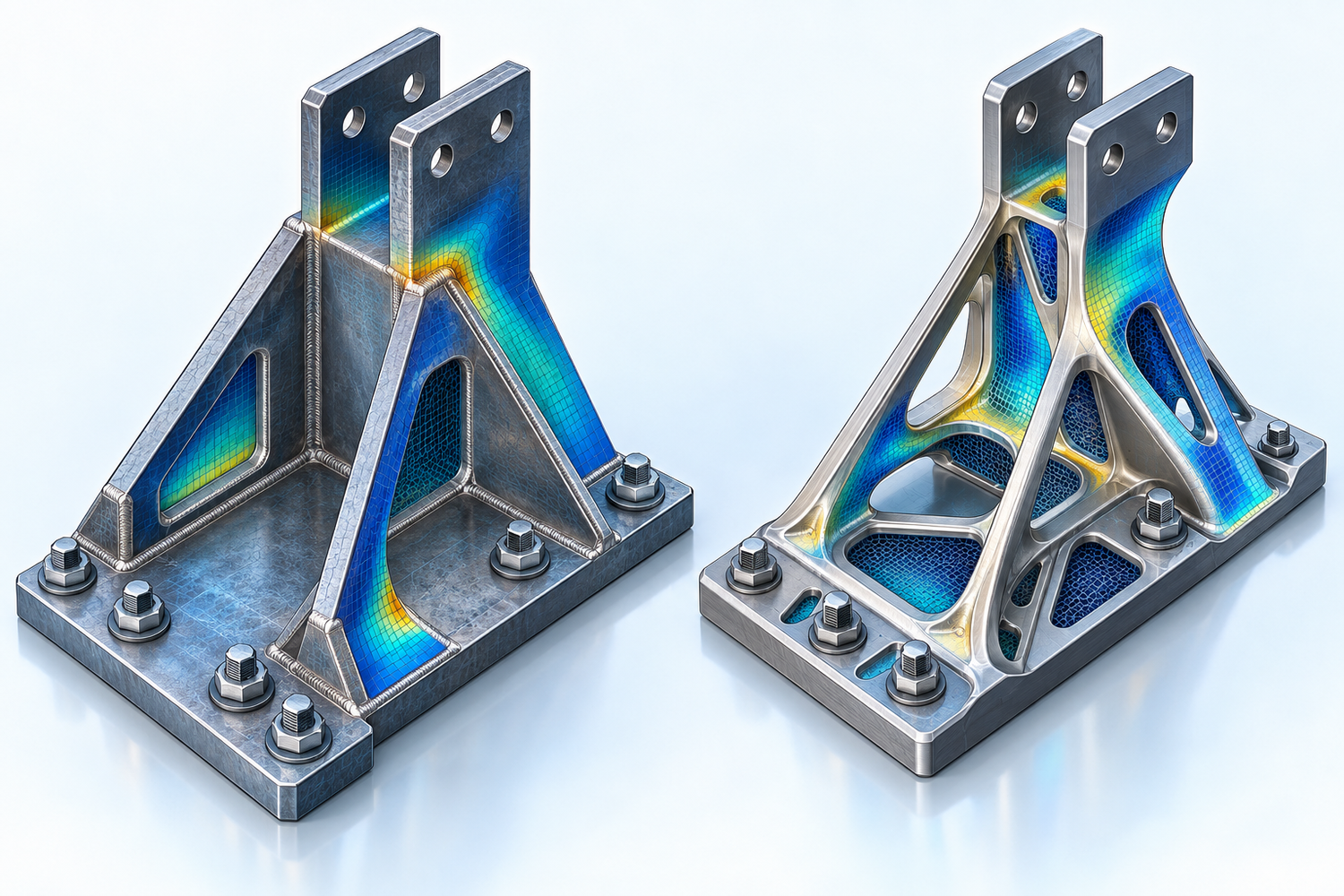
Optimization Approach
Optimization for Manufactured & Pre-Engineered Products
Our optimization work focuses on:
Clarifying how geometry, stiffness, and detailing influence system behavior
Identifying where material can be reduced without compromising required performance objectives
Evaluating how manufacturing variation affects reliability
Supporting value-engineering efforts with physics-based reasoning rather than shortcuts
Helping teams understand the reliability envelope of their product series
Improving consistency across production, installation, and long-term performance
This work often results in:
More reliable product families
Lower material usage and reduced cost
Improved consistency across manufacturing and installation
Clearer alignment between design intent and real-world behavior
Blast Design & Dynamic Response
Blast design requires understanding how short-duration loading interacts with the whole structural system. Catlow Consulting supports blast-resistant design through analysis of dynamic response, load paths, and the interaction of members, connections, and supports.
Useful when: A protective-design question calls for evaluation of blast loading and structural response.

Technical reference: TM 5-1300
Our blast-design work references TM 5-1300, Structures to Resist the Effects of Accidental Explosions. Its treatment of blast effects and structural dynamics informs the analytical approach.
Blast Design Support
Clarifying loading assumptions and the structural-response question
Evaluating component behavior within the connected system
Examining the role of connection detailing and support conditions
Comparing design alternatives against the project’s response objectives
The scope, project requirements, and role of the licensed engineering team are established at the outset.
A Focused, Collaborative Approach
Every project begins with understanding the question that needs to be answered. We work with the client’s team to:
Define the Question
Define the scope and decision to be supported
Review the Evidence
Review available information and constraints
Choose the Method
Select an appropriate analytical or consulting approach
Clarify the Next Step
Present findings clearly, with assumptions and limitations stated upfront
This ensures the work directly supports the next step—whether that means further investigation, comparing alternatives, refining a product, or improving a process.
Methods Shaped Around the Problem
Our workflow is structured, reproducible, and tailored to each project. It often includes:
Structured assumption modeling
Clarifying what is known, what is assumed, and how those assumptions influence results.
Reliability framing
Evaluating how design lineage, manufacturing variation, installation practice, and observed performance interact.
Sensitivity and DOE-based evaluation
Exploring how changes in key variables affect system behavior and identifying the variables that matter most.
Response-based interpretation
Focusing on what the system is actually doing rather than pursuing analytical complexity that does not improve the decision.
Collaborative technical review
Working directly with the people closest to the system, product, or process.
Together, these methods provide a disciplined analytical framework built around reproducibility, physical behavior, and practical engineering judgment.
Applications
Catlow’s capabilities may support projects involving:
Structural performance questions
Component or system evaluation
Reliability-focused review of building series or manufactured products
Simulation of defined operating or loading conditions
Blast design and dynamic structural response
Optimization of pre-engineered or manufactured components
Manufacturing process challenges
Technical problem-solving with engineering and production teams
Comparison of potential approaches or scenarios
Start a Conversation
Have a structural or manufacturing challenge to work through?
Contact us to discuss the question, available information, and whether our capabilities are a fit.
Contact Catlow Consulting